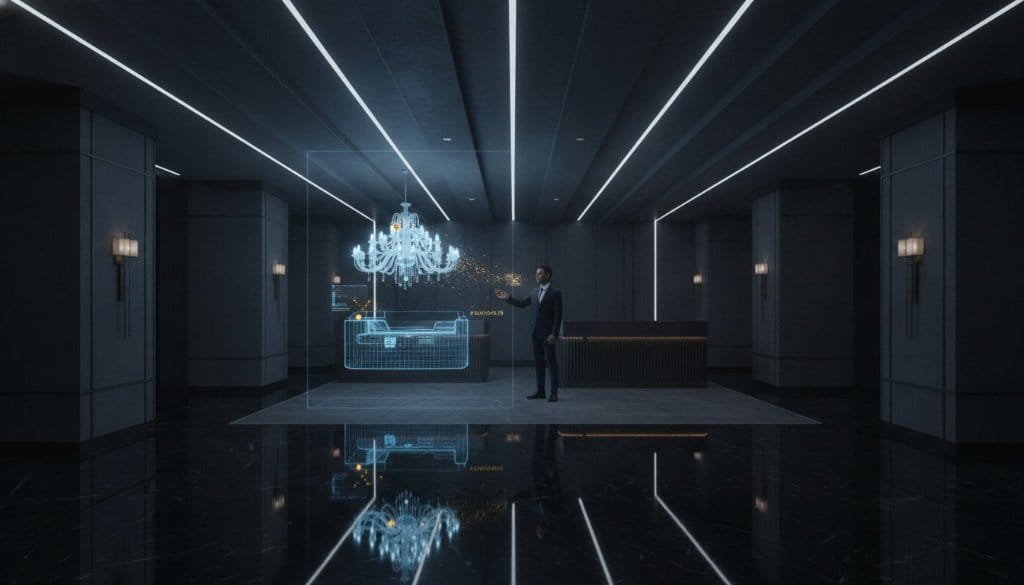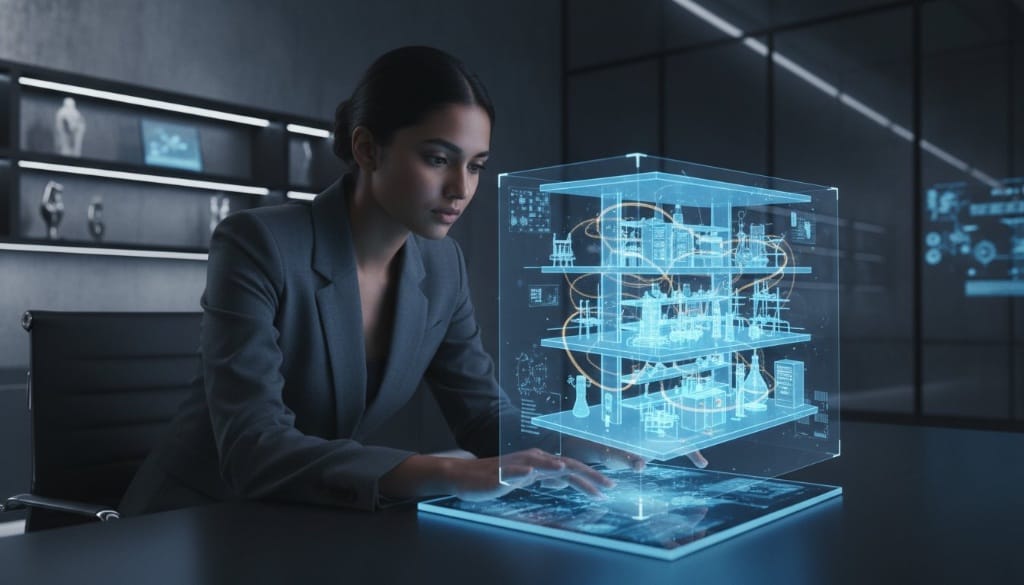
What if the glass screen of a laptop wasn't a barrier to education, but a high-fidelity portal to a restricted research lab or a complex industrial site? The standard virtual tour for online learning has often been little more than a static slideshow; a flat experience that fails to capture the soul of a physical space. It's an incomplete solution for a high-stakes environment. We've moved beyond passive observation. Today, sophisticated digital twins allow students to navigate, interact, and master technical skills without the logistical burden of physical site visits.
You likely recognize that remote learning often feels disconnected, leaving students disengaged and instructors struggling to teach hands-on skills from a distance. It's a challenge that demands more than just video. This guide reveals how high-fidelity digital twins and interactive spatial environments are revolutionizing student engagement and technical training outcomes. We'll explore the shift toward discovery-based learning, the critical 2026 ADA compliance standards for digital accessibility, and the scalable technology behind 3D spatial environments that bring physical depth to digital education.
Key Takeaways
- Define the evolution from basic 360-degree imagery to persistent, data-rich digital twins that mirror physical reality with absolute precision.
- Explore how the psychological concept of "Presence" transforms passive observation into active, discovery-based learning to boost knowledge retention.
- Learn to implement a virtual tour for online learning through a structured approach that prioritizes pedagogical objectives over mere visual novelty.
- Compare the visual fidelity of Matterport dollhouse views against standard panoramas to choose the most effective medium for your specific training goals.
- Uncover how custom interactive software layers can elevate a standard 3D scan into a sophisticated, scalable platform for high-stakes technical training.
What is a Virtual Tour for Online Learning in 2026?
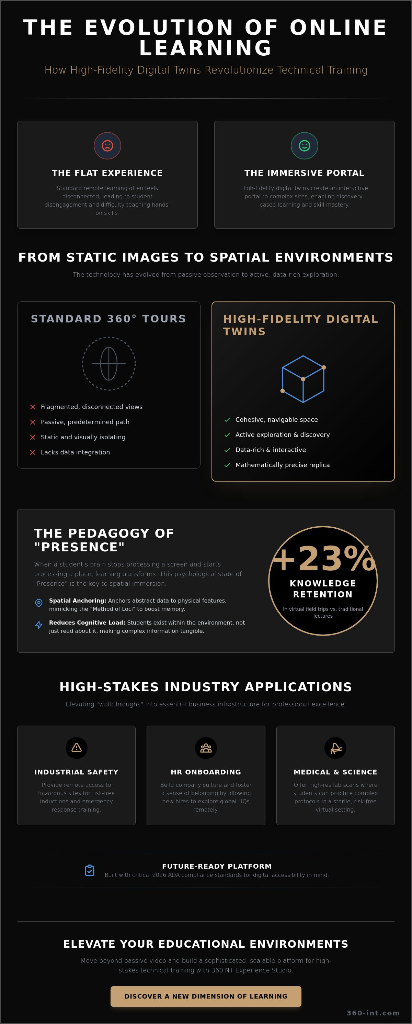
A virtual tour for online learning in 2026 is no longer a sequence of flat, disconnected images. It is a persistent, high-fidelity 3D digital twin. While standard 360-degree photography offers a fragmented view of a room, a spatial digital twin provides a cohesive, data-rich environment that mirrors reality with mathematical precision. This evolution replaces passive observation with active exploration. Students don't just watch a tour; they inhabit a learning space. This technology bridges the gap in hybrid education, offering a level of access that was once restricted by geography, budget, or safety concerns.
The difference lies in the depth of intelligence layered onto the physical form. Traditional panoramas are static and isolating. Modern 3D virtual tours, powered by advanced LiDAR mapping and photogrammetry, allow for seamless movement and interaction. This creates a functional platform where data points, instructional videos, and live assessments are embedded directly into the architecture of the virtual site.
The Shift from Passive to Active Participation
Passive video consumption often leads to a cognitive disconnect. It is easy to tune out when the path is predetermined by a camera lens. In a sophisticated virtual tour for online learning, agency is the primary driver of engagement. The student possesses the power to choose their own perspective, deciding exactly where to look and which details to investigate. This autonomy is a pedagogical necessity. Spatial navigation mimics real-world cognitive mapping, which significantly aids long-term knowledge retention. By allowing students to control their journey, we transform the screen from a barrier into a portal for discovery.
Beyond the Classroom: Corporate and Industrial Use Cases
The application of this technology extends far beyond traditional academic settings. In high-stakes industrial sectors, high-fidelity scans are transforming how organizations approach safety and training. These environments provide a scalable solution for several critical functions:
- Industrial Safety: Provide safe remote access to hazardous or restricted sites for site inductions and emergency response training without physical risk.
- HR Onboarding: Build company culture by allowing new hires to explore global headquarters and immersive workspaces, fostering a sense of belonging remotely.
- Medical and Science Education: Offer high-resolution laboratory scans where students can practice complex protocols in a sterile, risk-free virtual setting.
This approach identifies the basic industry standard of "walkthroughs" and elevates them into essential business infrastructure. It ensures that the digital replica is not just a visual asset, but a purposeful environment designed for professional excellence.
The Pedagogy of Presence: Why Spatial Immersion Works
Presence isn't a feature. It's a psychological state. When a student enters a high-fidelity digital twin, their brain stops processing a screen and starts processing a place. This is the core of spatial immersion. Traditional online modules often fail because they lack context; they present information in a vacuum. By contrast, a sophisticated virtual tour for online learning provides a physical anchor for every piece of data. This reduces cognitive load. Instead of struggling to visualize a complex environment from a manual, students simply exist within it. The abstract becomes tangible.
Discovery-based learning flourishes in these environments. It moves the student from a passive recipient of facts to an active explorer of spaces. This transition is vital for technical mastery. When you navigate a 3D scan of a turbine or a medical laboratory, you aren't just memorizing steps. You're building a mental map. According to a 2023 study, students participating in virtual field trips retained 23% more content than those in traditional lecture-based settings. The reason is simple: the brain is hardwired to remember locations better than bullet points.
Spatial Anchoring and Memory
The "Method of Loci" is an ancient mnemonic strategy that involves associating information with specific physical locations. In a 3D digital twin, this happens naturally. Students associate specific facts with the physical equipment or architectural features they encounter during their walkthrough. For example, learning the layout of a complex industrial facility becomes intuitive when the student has "walked" the floor multiple times virtually. This spatial anchoring ensures that knowledge is not just acquired but deeply embedded in long-term memory, mimicking the way we learn in the physical world.
Gamification and Engagement Layers
Engagement is often the first casualty of remote education. To combat this, we layer intelligence onto physical forms. Interactive hotspots can trigger multimedia content or real-time quizzes, forcing the student to interact with the environment to progress.
- Interactive Quizzes: Embed assessments directly onto the specific machinery or site features being studied.
- Scavenger Hunts: Drive exploration by requiring students to find and interact with specific spatial markers.
- Data Tracking: Monitor student movement patterns to identify where they struggle or lose interest.
Digital Twins vs. Standard 360 Video: Choosing Your Format
Traditional 360-degree video is a flat window. It offers a passive observation of a pre-rendered path, leaving the student as a spectator rather than an active participant in their own education. For a truly effective virtual tour for online learning, this surface-level approach is insufficient. In 2026, educational leaders are moving toward high-fidelity digital twins. These aren't just videos; they are intelligent, three-dimensional models that capture the soul of a physical space. The difference is operational. While a video is a static file, a digital twin is a functional platform that can be measured and explored with total autonomy.
The Power of High-Fidelity Spatial Scans
Professional 3D scans are the gold standard for technical training and architectural study. Their primary advantage is the "Dollhouse View." This unique perspective allows students to rotate and observe an entire structure as a cohesive 3D model before entering specific rooms. It is essential for understanding complex spatial relationships in industrial sites or medical facilities. When paired with LiDAR technology, these scans provide measurement-accurate documentation.
The Constraints of Traditional 360 Video
Traditional 360 video is inherently linear. It forces the student to follow a predetermined path, which effectively kills self-paced discovery. This lack of agency is a major barrier to engagement. There's also the "motion sickness" factor. In low-quality VR environments, forced movement that doesn't align with the user's intent causes significant discomfort and cognitive fatigue. Perhaps most importantly, video is difficult to maintain. Updating a single piece of equipment in a lab requires a complete reshoot. A digital twin is modular — you can update specific data points or interactive layers without starting from scratch.
How to Implement a Virtual Tour for Online Learning
Implementation is more than a technical task. It is an architectural strategy. A successful virtual tour for online learning demands a structured workflow that moves beyond simple visual capture. The roadmap to a sophisticated learning environment follows five essential stages:
- Step 1: Learning Objectives. Define the student's purpose. Are they performing a site induction, mastering complex machinery, or conducting a virtual lab experiment?
- Step 2: High-Fidelity Scanning. Capture the physical space using advanced 3D scanning technology and LiDAR mapping to create a measurement-accurate digital replica.
- Step 3: Layering Intelligence. Embed interactive data points that provide context, instruction, and sensory depth.
- Step 4: LMS Integration. Seamlessly embed the experience into platforms like Canvas or Moodle for a unified, professional student journey.
- Step 5: Measurement and Optimization. Utilize spatial heatmaps to track student movement and identify precisely where engagement peaks or drops.
Defining Interactive Learning Hotspots
A Learning Hotspot is an interactive data point embedded within a 3D coordinate. By anchoring PDFs, instructional videos, or live web frames to specific physical objects within the scan, we create layered intelligence. You can even implement gatekeeping mechanics — students must find and interact with specific safety markers or equipment components to unlock the next level of the training. This gamified approach ensures discovery is both purposeful and measurable.
Ensuring Accessibility (WCAG) and Cross-Platform Use
In 2026, accessibility is a non-negotiable standard. Public institutions serving populations over 50,000 must meet WCAG 2.1 Level AA standards by April 24, 2026. This requires a virtual tour for online learning to be fully navigable via keyboard and compatible with screen readers. We provide text-based alternatives for all spatial data, ensuring every student has an equitable experience. These tours must also be mobile-responsive.
Elevating Educational Environments with 360INT Experience Studio
A standard 3D scan is a digital shell. It captures the geometry but often misses the purpose. At 360INT Experience Studio, we believe a virtual tour for online learning should be more than a visual walkthrough; it must be a functional, intelligent platform. By layering proprietary software onto high-fidelity Matterport scans, we turn static environments into dynamic training hubs that deliver measurable business results and profound student engagement.
Our approach is rooted in the idea of spatial intelligence. We don't just provide hardware solutions. We act as visionary architects of digital worlds who bring a sense of purpose to data-driven environments. Our MICE-grade measurement tools allow instructors to see exactly how students navigate, providing deep insights into learning behaviors that traditional modules simply cannot capture.
Custom Software Layers for Interactive Learning
We develop proprietary overlays that transform a simple scan into a sophisticated training ecosystem. These layers allow for the integration of live data feeds and custom e-learning logic directly into the 3D coordinate system. Consider science education environments that allow remote lab experiments. Instead of just reading about a centrifuge, students interact with a digital twin that responds to their inputs in real time.
The Future of Spatial Intelligence in Education
The era of static modules and flat panoramas is over. In its place, the virtual tour for online learning has emerged as a sophisticated, interactive ecosystem that prioritizes student agency and measurable results. By transitioning from passive observation to discovery-based navigation, institutions can secure higher retention rates and provide safe, remote access to high-stakes environments.
With over 10 years of experience in 3D marketing and a status as a Matterport Service Partner specializing in custom tech, we bridge the gap between physical reality and digital capability. Our high-fidelity production standards ensure that your training environments are globally scalable and visually evocative.
Frequently Asked Questions
What is the difference between a 360 tour and a virtual tour for online learning?
A standard 360 tour is a collection of flat panoramas that offer a restricted, predetermined view of a space. A virtual tour for online learning is a measurement-accurate digital twin that allows for total spatial autonomy. While panoramas are static, digital twins provide a "dollhouse" perspective and LiDAR-backed precision. This creates a functional platform where students interact with embedded intelligence rather than merely observing a slideshow.
Can I integrate a virtual tour into my existing LMS like Moodle or Canvas?
You can seamlessly integrate 3D virtual tours into major Learning Management Systems like Moodle, Canvas, and Blackboard. Most platforms support direct embedding via iframe or custom LTI integrations. This ensures the immersive experience remains a native part of the student's existing workflow.
How do virtual tours improve student engagement in remote classes?
These environments improve engagement by shifting the student from a spectator to an active explorer. By providing agency, the student chooses their own path and perspective, which triggers a psychological state of "Presence." This active discovery mimics real-world cognitive mapping — a significant evolution from passive video consumption.
What hardware do students need to access an immersive 3D learning environment?
Students don't need specialized hardware or expensive VR headsets. High-fidelity digital twins are designed for cross-platform stability, functioning flawlessly on standard laptops, tablets, and smartphones. The experience is optimized for standard web browsers, ensuring accessibility regardless of technical equipment.
Are virtual tours accessible for students with disabilities (WCAG compliance)?
Accessibility is a core requirement for digital learning in 2026, and modern 3D spaces are built to meet WCAG 2.1 Level AA standards. This includes features like keyboard-only navigation, screen-reader compatibility, and text-based alternatives for spatial data — essential for public institutions facing the 2026 and 2027 ADA Title II compliance deadlines.
How do I measure the effectiveness of a virtual tour in my curriculum?
You can measure effectiveness through built-in analytics that track student movement and interaction data. Spatial heatmaps reveal exactly where students spend time and which interactive hotspots they engage with most. By correlating this data with assessment scores and completion rates, instructors can identify learning gaps and refine content.